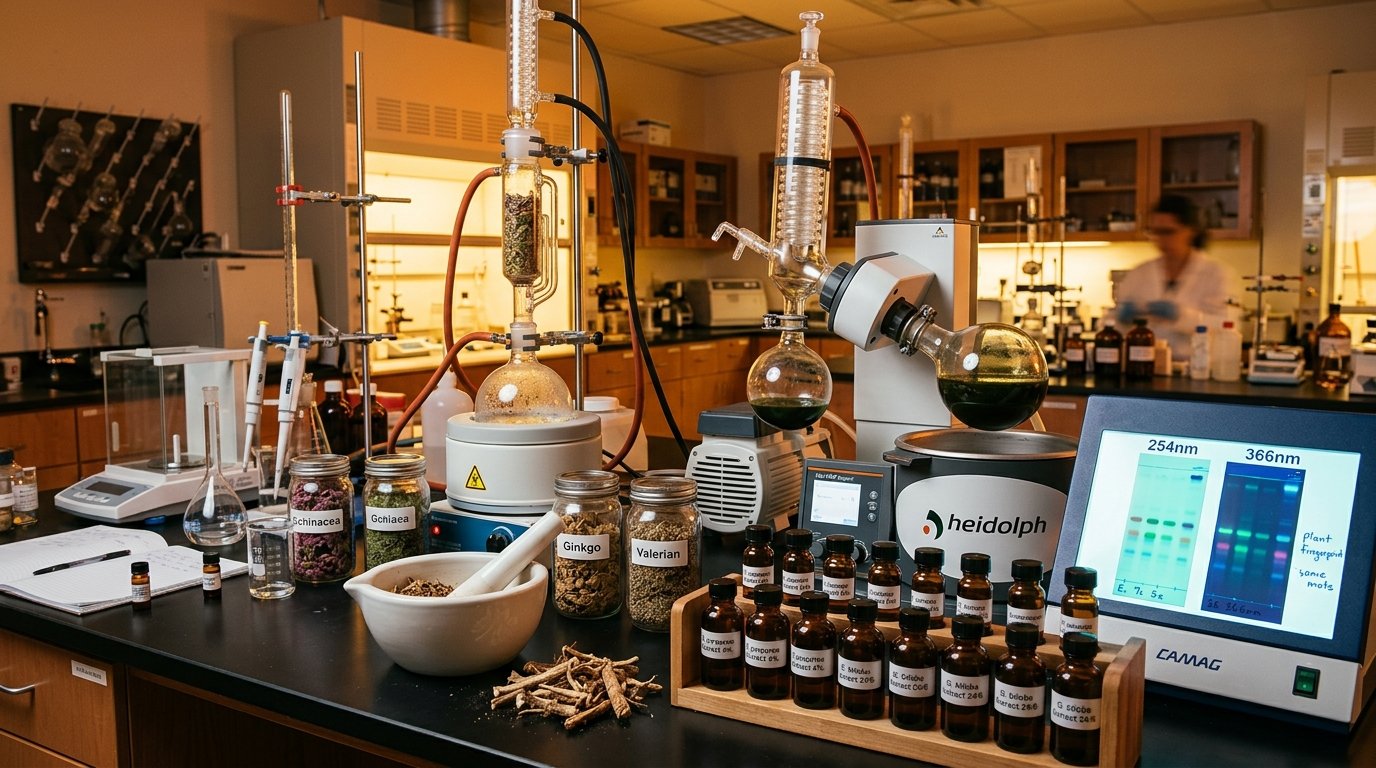
Scientific evaluation of medicinal plants through standardized extraction techniques, qualitative phytochemical profiling, HPTLC fingerprinting, quantitative marker estimation, and antioxidant capacity assessment — providing a rigorous phytoscientific foundation for herbal drug development.
Pharmacognosy bridges traditional botanical knowledge with modern analytical science. Our phytochemistry division applies validated extraction, standardization, and analytical methods to characterize plant materials, crude extracts, and herbal formulations. The resulting data supports academic publications, regulatory dossiers, and quality control frameworks for herbal drug development.
PharmacognosyMacroscopic and microscopic identification of authenticated plant material. Determination of loss on drying, total ash, acid-insoluble ash, and extractive values (water, alcohol) as per IP/BP pharmacopoeial standards. Sequential extraction using Soxhlet apparatus (petroleum ether → chloroform → methanol → water), maceration, percolation, or cold infusion — solvent selected based on target compound polarity. Yield calculation and physical characterization of dried extracts (color, odor, consistency, pH).
Systematic chemical group tests for major secondary metabolites: alkaloids (Dragendorff, Wagner, Mayer), flavonoids (Shinoda test), tannins (ferric chloride, lead acetate), saponins (foam test), glycosides (Keller-Kiliani), steroids & triterpenoids (Liebermann-Burchard), phenols, and proteins (Biuret, Ninhydrin). Results documented as present/absent with photographic documentation of color reactions.
Development of HPTLC chromatographic fingerprint profiles using CAMAG system for botanical extract characterization and adulteration detection. Quantification of active phytomarkers (quercetin, rutin, kaempferol, caffeic acid, curcuminoids, piperine, glycyrrhizin, berberine, andrographolide) using densitometric scanning at 254/366 nm. Reference markers sourced from certified suppliers. Multi-extract comparative fingerprinting and band identification by Rf value comparison.
Colorimetric spectrophotometric estimation of: Total Phenolic Content (TPC) by Folin-Ciocalteu method (expressed as GAE/g), Total Flavonoid Content (TFC) by AlCl3 complexation (expressed as QE/g), Total Tannin Content by vanillin-HCl method, Total Alkaloid Content by gravimetric method, and Saponin content by gravimetric method. Standard curves prepared using certified reference standards.
Multiple free-radical scavenging and antioxidant capacity assays: DPPH (IC50 determination at 517 nm, compared to ascorbic acid/BHT), ABTS radical decolorization assay (Trolox equivalent), FRAP (Ferric Reducing Antioxidant Power, expressed as FeSO4 equivalent), and nitric oxide radical scavenging. Dose-response curves and IC50 values calculated from non-linear regression.
Botanical identification, macroscopic/microscopic examination, and basic physicochemical parameters (ash, extractive values, moisture).
Sequential or single solvent extraction by Soxhlet/maceration. Filtered, concentrated, dried, and yield % calculated on dry weight basis.
Qualitative group tests performed on all extract fractions. Color reactions documented and tabulated.
Standard curves prepared; TPC, TFC, phytomarker content, and antioxidant IC50 determined.
Complete phytochemical report with extraction yield tables, screening results, HPTLC chromatograms, calibration curves, and quantitative data.
Discuss your research requirements
Our phytochemistry team is ready to discuss your botanical research requirements.