High-resolution liquid and thin-layer chromatographic method development, validation, and quantitative analysis for pharmaceutical, phytochemical, and nutraceutical samples — aligned with ICH Q2(R1) guidelines and peer-reviewed scientific documentation standards.
Analytical chromatography provides the quantitative backbone for evaluating chemical identity, purity, potency, and stability of pharmaceutical substances. Our laboratory offers method development and validation services using industry-grade HPLC and CAMAG HPTLC systems, generating data packages suitable for thesis submission, journal publication, or regulatory dossier preparation. All analyses are performed with traceable reference standards and calibrated instrumentation.
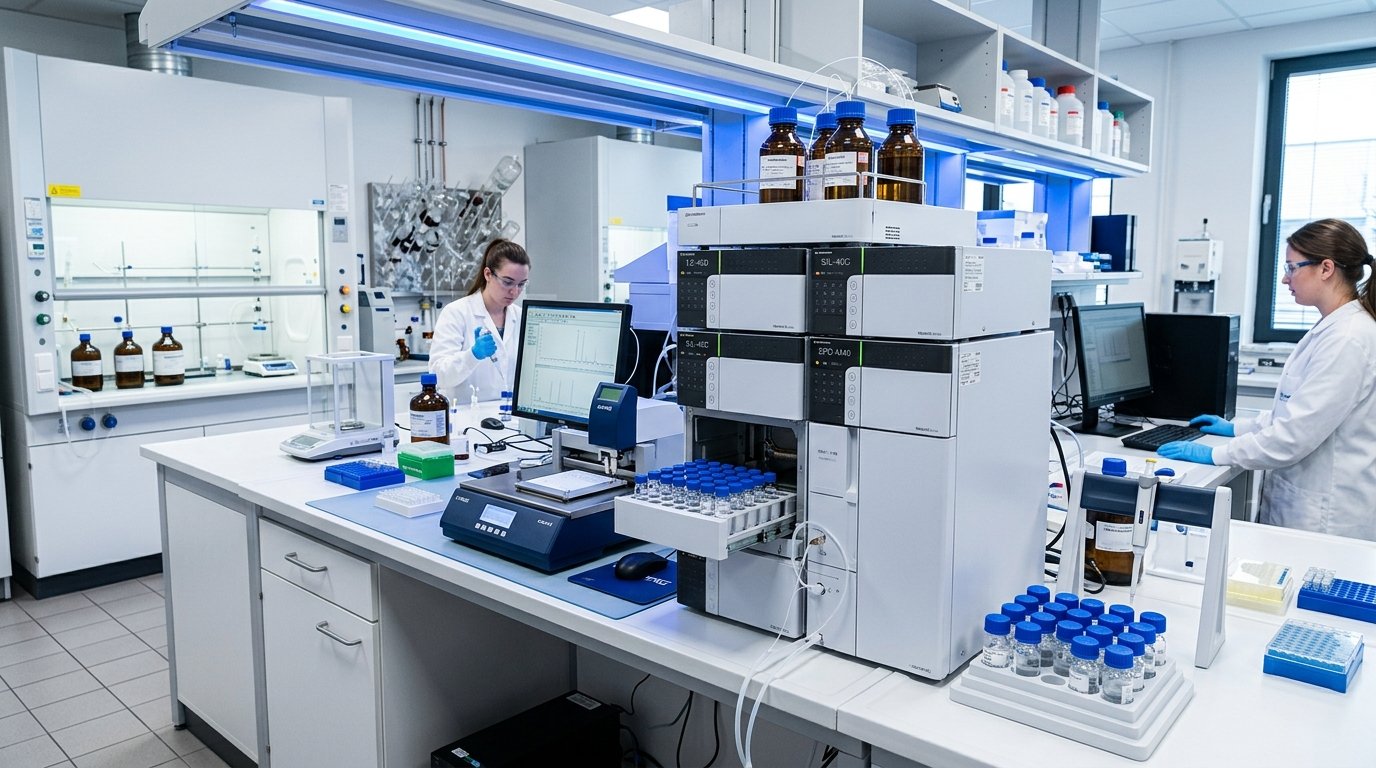
Shimadzu HPLC System
Development and optimization of isocratic and gradient reverse-phase HPLC methods using C18, C8, and phenyl columns. Mobile phase optimization (aqueous-organic), wavelength selection (UV/DAD/PDA detection), and flow rate optimization. ICH Q2(R1) validation parameters: linearity (R² > 0.999), accuracy (% recovery), precision (% RSD intra/inter-day), LOD & LOQ, robustness (Plackett-Burman design), and system suitability.
High-Performance Thin-Layer Chromatography (HPTLC) using CAMAG Automatic TLC Sampler (ATS 4/5), CAMAG Scanner III (dual-wavelength 254/366 nm densitometry), and WinCATS software. Applications: botanical extract fingerprinting, active phytomarker quantitation (e.g., quercetin, berberine, curcumin, piperine, ursolic acid), multi-component standardization, and comparative chromatographic profiles.
Single and double-beam UV-Vis spectrophotometric analysis for drug content determination, dissolution sample analysis, and preliminary method scouting. Wavelength scanning (200–800 nm), Beer-Lambert linearity establishment, and chromogenic reaction-based assays (Folin-Ciocalteu TPC, DPPH radical scavenging, Dithiozone metal complexation).
ICH Q1A(R2)-guided stability studies including acid hydrolysis, base hydrolysis, oxidative degradation, photolysis (UV/fluorescent), and thermal stress. Chromatographic peak purity assessment using PDA detection. Impurity profile generation and mass balance calculation to demonstrate method specificity.
Quantitative drug content determination from pharmaceutical dosage forms (tablets, capsules, gels, suspensions) and novel drug delivery systems (nanoparticles, liposomes, microparticles) using validated HPLC or UV methods. In-vitro drug release profiling from NDDS using USP apparatus I/II with dialysis membrane systems at physiological pH conditions.
Review of existing analytical methods, procurement of certified reference standards (Sigma-Aldrich, HPCL, USP) with CoA, and mobile phase system selection.
Column screening, mobile phase composition trials (aqueous:organic ratio), pH optimization, flow rate, detection wavelength, and injection volume finalization.
Evaluation of tailing factor (≤2.0), theoretical plates, resolution (≥2.0), capacity factor, and relative standard deviation of peak area (≤2%) across 6 replicate injections.
Linearity (5 concentration levels, triplicate), accuracy (3 levels × 3 reps), intra-day and inter-day precision, LOD/LOQ, robustness, and specificity studies executed.
Validated method applied to actual samples. Complete analytical report with chromatograms, calibration curves, validation tables, and interpretive summary.
Analytical method development chapters for formulation or phytochemical dissertations requiring validated ICH-compliant HPLC/HPTLC methods.
HPTLC fingerprint profiles and phytomarker standardization reports for product dossiers, quality control, or scientific substantiation of botanical claims.
Drug content assay, encapsulation efficiency determination, and in-vitro drug release profiling for novel formulation characterization and regulatory submission support.
Discuss your analytical testing requirements
Connect with our analytical chemistry team for a scientific discussion.