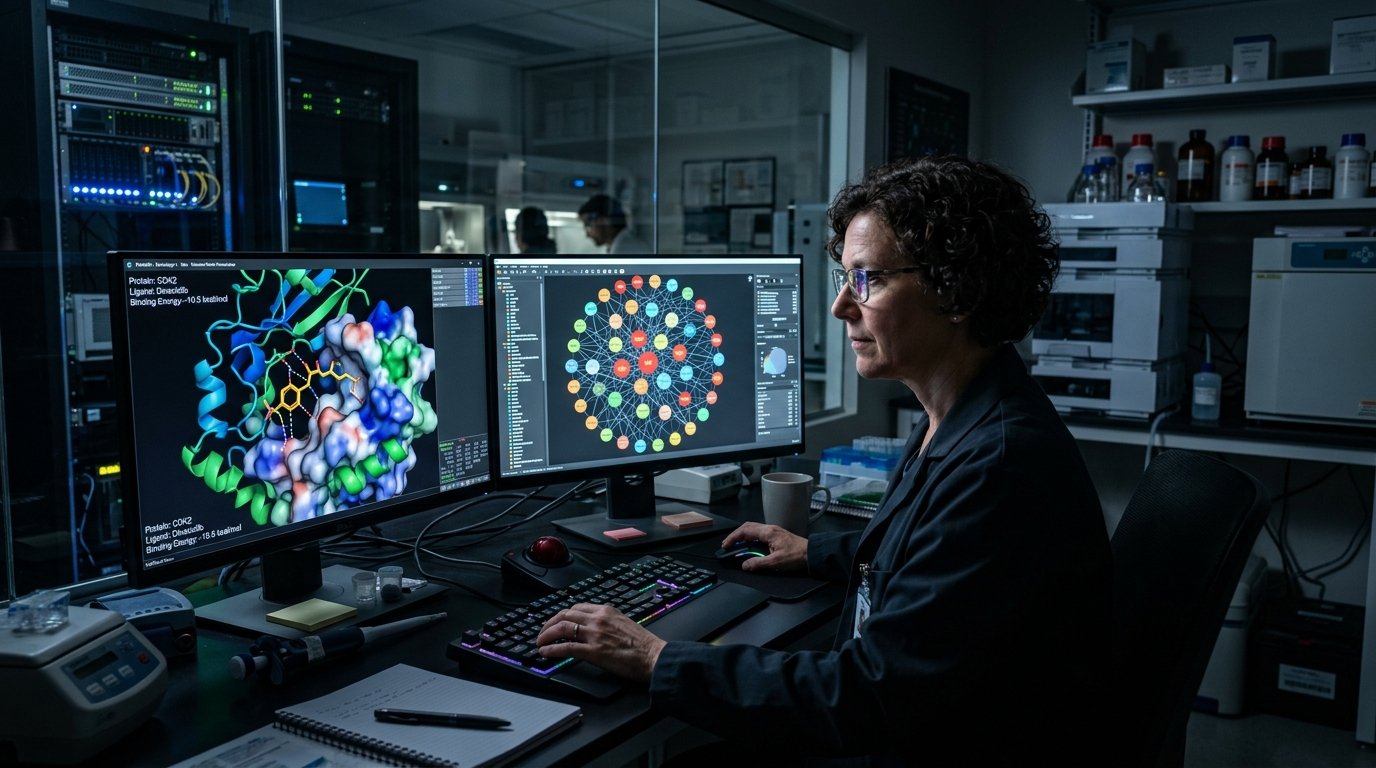
Protein-ligand molecular docking, virtual screening, pharmacokinetic/ADMET prediction, Network Pharmacology multi-target identification, and pathway enrichment analysis — providing mechanistic in-silico evidence to complement and guide experimental research strategies.
Computational approaches have become an integral component of modern drug discovery, enabling rapid and cost-efficient exploration of molecular interactions, pharmacokinetic behavior, and multi-target therapeutic mechanisms. Our in-silico division provides analysis workflows commonly reported in high-impact pharmacology and medicinal chemistry publications, with transparent methodology and reproducible results using established open-source and commercial platforms.
AutoDock Vina Molecular DockingProtein-ligand molecular docking using AutoDock Vina (semi-empirical free energy force field) or HDOCK for protein-protein docking. Target protein crystal structures retrieved from RCSB Protein Data Bank (PDB); water molecules removed, polar hydrogens added, Gasteiger charges assigned using AutoDockTools. Ligands prepared in PDBQT format using Open Babel. Grid box defined over active/allosteric site. Best-pose selected based on binding free energy (ΔG, kcal/mol) and key hydrogen bond interactions visualized in BIOVIA Discovery Studio / PyMOL.
In-silico prediction of Absorption, Distribution, Metabolism, Excretion, and Toxicity (ADMET) properties using SwissADME, pkCSM, and ADMET Lab 2.0. Lipinski's Rule of Five (RO5) compliance, Veber's rule for oral bioavailability, blood-brain barrier penetration (log BB), CYP450 enzyme inhibition, AMES mutagenicity, hERG toxicity, and carcinogenicity prediction. Bioavailability radar and BOILED-Egg model plot generated.
Multi-target multi-pathway analysis integrating: (1) target prediction for bioactive compounds using SwissTargetPrediction, PharmMapper, TargetNet; (2) disease-specific target collection from GeneCards, OMIM, DisGeNET, TTD; (3) common target identification via Venn diagram intersection; (4) protein-protein interaction (PPI) network construction using STRING database (confidence score ≥ 0.7) and Cytoscape visualization; (5) hub gene identification by betweenness/degree centrality metrics; (6) GO Biological Process and KEGG pathway enrichment via DAVID / Metascape / g:Profiler.
Short-trajectory (10–50 ns) molecular dynamics simulation of docked protein-ligand complexes using GROMACS with AMBER/CHARMM force fields to assess binding complex stability. Key metrics: RMSD (Root Mean Square Deviation), RMSF (Root Mean Square Fluctuation), radius of gyration (Rg), and hydrogen bond persistence over the simulation trajectory. Used to validate docking results and assess conformational stability of the lead complex.
3D pharmacophore model generation from known active ligands using LigandScout or Phase (Schrödinger). Features defined: hydrogen bond donors/acceptors, hydrophobic centers, aromatic rings, ionizable groups, and excluded volumes. Virtual screening of chemical libraries (ZINC, PubChem) against pharmacophore model to identify structurally diverse lead candidates for experimental validation.
Target protein PDB ID selected/retrieved. Compound 2D structures drawn in ChemDraw / Marvin Sketch, energy minimized, and converted to 3D PDBQT/SDF format.
Protein structure prepared (water removal, hydrogen addition, charge assignment). Active site coordinates defined using co-crystallized ligand or binding site residue literature.
AutoDock Vina run (exhaustiveness: 8–32). Best pose selected by lowest ΔG. H-bond, hydrophobic, and π-stacking interactions identified using Discovery Studio.
SwissADME and pkCSM analysis run for all docked compounds. Lipinski compliance, oral bioavailability, toxicity flags, and CYP interaction assessed.
Target prediction, PPI construction, hub gene extraction, and KEGG/GO enrichment analysis completed with bubble/dot plot visualization.
Comprehensive report with docking pose images, binding energy tables, ADMET data, network figures (PPI, pathway maps), and interpretive narrative suitable for manuscript submission.
Discuss your computational research needs
Our computational team can help design the right in-silico study for your research.