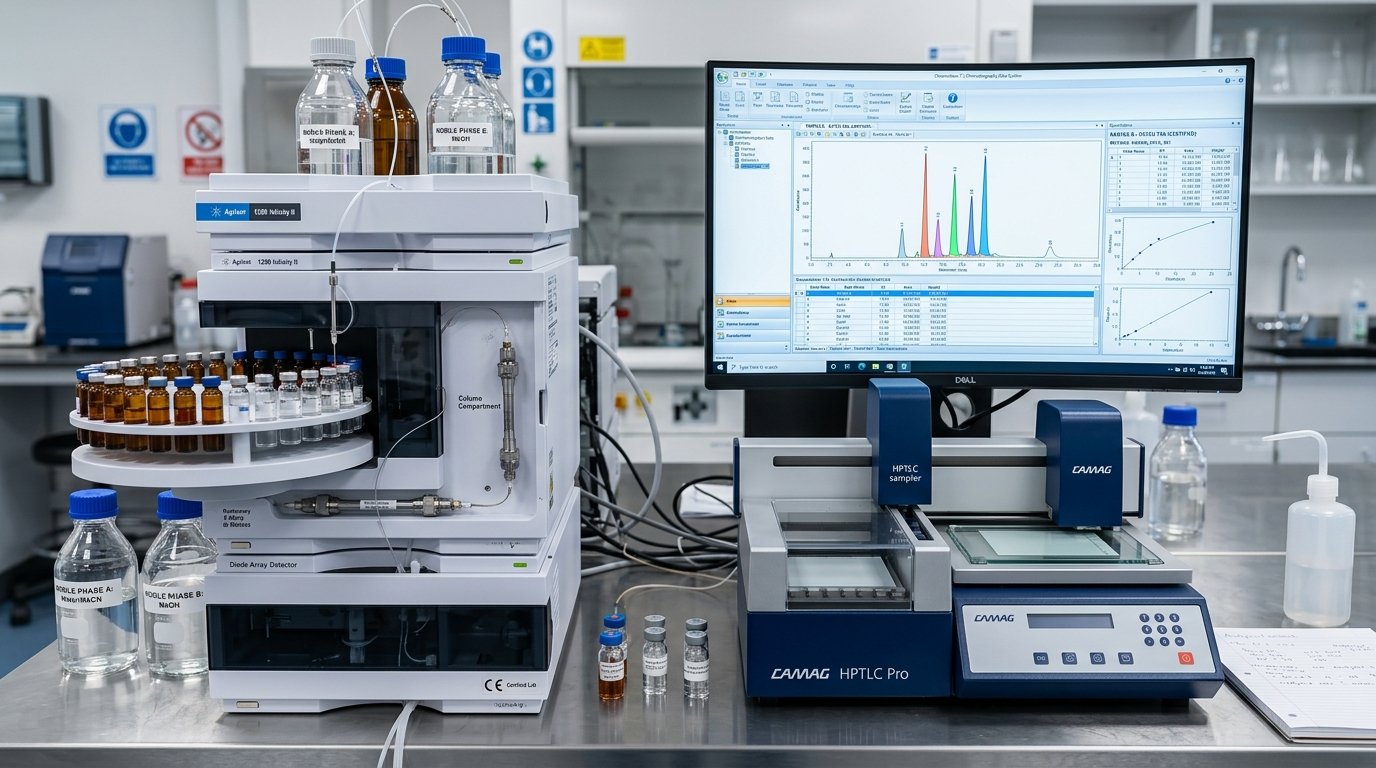
Preformulation characterization, development and optimization of conventional and novel drug delivery systems (nanoparticles, liposomes, SEDDS, hydrogels), in-vitro drug release profiling, and ICH Q1A stability evaluation — providing a comprehensive pharmaceutics data package for academic and industrial drug development programs.
Pharmaceutical formulation science bridges drug discovery and clinical application, translating bioactive candidates into dosage forms with optimized bioavailability, stability, and therapeutic targeting. Our pharmaceutics division supports the development of both conventional (tablets, capsules, suspensions) and novel drug delivery systems (nanoparticles, self-emulsifying systems, liposomes, hydrogels) with rigorous in-vitro characterization and stability evaluation.
NDDS Formulation SuitePhysical and chemical characterization of drug substance prior to formulation: melting point, solubility profiling (in water and biorelevant media — FaSSIF, FeSSIF), partition coefficient (log P by shake flask), pKa estimation, hygroscopicity, photosensitivity, drug-excipient compatibility by DSC (Differential Scanning Calorimetry) and FTIR spectroscopy, and flow property assessment (bulk/tapped density, Carr's index, Hausner ratio, angle of repose).
Development of polymeric nanoparticles (PLGA, chitosan, albumin) by nanoprecipitation or double emulsion method, solid lipid nanoparticles (SLNs), and nanostructured lipid carriers (NLCs). Characterization: particle size distribution (DLS), zeta potential (ZP), polydispersity index (PDI), TEM/SEM morphology. Entrapment efficiency (EE%) and drug loading (DL%) determined by centrifugation/ultracentrifugation followed by HPLC/UV quantification.
Multilamellar vesicles (MLVs) and small unilamellar vesicles (SUVs) prepared by thin film hydration method with probe sonication / extrusion. Phospholipid-cholesterol composition optimized for targeted application (PEGylated stealth liposomes for sustained release; cationic liposomes for gene delivery support). Encapsulation efficiency determined by mini-column centrifugation; vesicle size by DLS; morphology by TEM.
Self-Emulsifying Drug Delivery Systems (SEDDS) and Self-Micro-Emulsifying Systems (SMEDDS) development for poorly water-soluble BCS Class II/IV drugs. Pseudo-ternary phase diagram construction to identify optimal oil:surfactant:co-surfactant ratios. Cloud point determination, emulsification time, droplet size, and thermodynamic stability studies (heating-cooling cycles, centrifugation, freeze-thaw).
Dissolution testing using USP Apparatus I (basket, 100 rpm) and Apparatus II (paddle, 50–100 rpm) in simulated gastric fluid (SGF pH 1.2), simulated intestinal fluid (SIF pH 6.8), and phosphate buffer (pH 7.4). Drug release from nanoparticulate systems using dialysis bag technique against receptor medium. Cumulative % drug release plotted against time; release kinetics modeled using zero-order, first-order, Higuchi, Korsmeyer-Peppas, and Hixson-Crowell equations using DDSolver.
Accelerated stability studies per ICH Q1A(R2): 40°C/75%RH (accelerated) and 25°C/60%RH (intermediate) for conventional dosage forms; long-term 25°C/60%RH for regulatory submissions. Nanoparticulate stability: particle size, ZP, and EE% monitored over 1–3 months at refrigerated (4°C) and room temperature conditions. Photostability per ICH Q1B. Parameters assessed: physical appearance, drug content by HPLC, pH, viscosity.
Drug physicochemical characterization; definition of target product profile (route, release rate, patient population); excipient compatibility screening.
Selection of formulation approach (NDDS type); initial batch preparation using design-of-experiment (DoE) or trial-and-error optimization with key quality attributes (CQAs) monitored.
Particle size, ZP, PDI, EE%, DL%, DSC, FTIR, XRD (crystallinity), SEM/TEM morphology.
Dissolution or dialysis-based drug release at multiple pH conditions; kinetic model fitting using DDSolver/Sigma Plot.
Accelerated and room temperature stability studies. Physical and chemical stability tracked at defined time points.
Complete formulation characterization report with optimization rationale, characterization data, release profiles, kinetic model parameters, and stability data.
Discuss your drug delivery system needs
Our pharmaceutics team is available to discuss NDDS development strategy.